Student/alumni voices

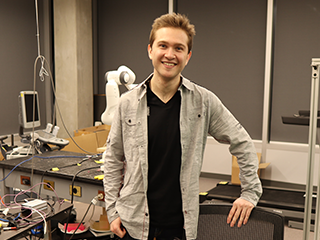
Scott SELLAND
 Canada
Master's course graduate September 2025
As a graduate of the e3 program, I often look back on my time at Hokkaido University—the hours I spent in the lab, the energy of the student clubs I joined, and the challenges and discoveries that came with job hunting. Through all of these experiences, I became increasingly aware of the differences between the values I encountered in Japan and those I grew up with in Canada. Seeing those differences through the eyes of an engineer gave me a deeper understanding of how culture shapes the way we work, collaborate, and solve problems.
You looked gorgeous on stage! Can you tell us more about your club experience? How can one join a club at Hokkaido University?
Usually, club recruitment activities start in April, and there is even a week when all the clubs display their posters along the main street. There is also a club directory you can find at [https://hubcnavi.net/]. My club was very active on social media; I saw their posters on campus as well as followed them on Instagram. When it came to joining, I must be frank: the system was not easy to navigate at first. Later, I understood why: Orchestra is a type of club called “bukatsu” (部活) in Japan. They are not light extracurricular activities you can join on a whim; they are quite a heavy commitment. Open house nights, welcome parties, instrument selection meetings, mentor assignment meetings, and much more are all part of the process everyone does when joining the orchestra.
However, there is no need to be discouraged! Club members were very welcoming and helped me navigate the process. I simply messaged them on Instagram and asked for help directly. Don’t be afraid to reach out directly to the members of the club you are interested in!

You mentioned the commitment, please tell us more about club life.
We had practices four times a week, for three hours each, and every member had some administrative duties. It really becomes your life outside of research and study, but the club atmosphere was very warm and collaborative. It was a full immersion into social life as experienced by Japanese students. I would absolutely recommend international students to join campus clubs!
We’ve heard that you are starting a new job in April. What kind of company are you planning to join?
The company I will be joining is a comprehensive engineering company, which specializes in the design, development, and production technology for industries for automotive, aerospace, and robotics. It's not a massive production company but mainly focuses on providing high-tech services to other companies. For me, it is not fully decided in which area of the company I will work until my company training is completed, but from what I've been told, it will most likely be aerospace, with possibly a small amount of robotics as well.
Are there any insights you could share with other students about what shūkatsu (job hunting in Japan) is and how to approach it?
As you may know, Japanese companies recruit fresh graduates on a fixed schedule, and everyone typically starts working in April, since March is a common graduation month. Since I started my degree in October and graduated in September, I now have half a year to enjoy my life while doing part-time work before joining the company.
What I would like to share is the difference between interviews in Canada and Japan. I did quite a few interviews with companies in Canada, and I can say that what was asked and what kind of answers were expected were quite different here in Japan. In Japan, you write many details in an “entry sheet” (an application where companies ask specific questions about your personality and experiences), and during the interview, the focus is more on your experiences as a person. For example: “Please tell us about a situation where you had to push yourself,” or “Tell us about a difficult situation where you didn’t give up.”
I based my answers on episodes from both Canada and Japan, including club activities. For example, the difficulty of standing alone on stage performing the violin. I felt that the interviews allowed me to be sincere and honest. What is valued by companies I think is something any international student can demonstrate: the ability to work hard and overcome difficulties. In Canada, I felt the focus was more on charisma and the ability to highlight impressive achievements.
You mentioned in the video that your research experience was different from that at a Canadian university, that you were more independent and that there was more theoretical research. Were there other differences?
Another important difference was the initiative students take in collaboration. For example, in Canada, our professors would give each student an individual task, and we were expected to work alone at our desks. In my laboratory at Hokkaido University, we always shared what we were working on with lab mates and could easily ask for help if we didn’t understand something. If two people were working on closely related topics, students would naturally take the initiative to collaborate. I would say there was more emphasis on the results we could achieve together rather than on individual achievement.
And finally, what do you think about studying engineering in Japan?
I think my field, Mechanical and Aerospace Engineering, is very advanced in Japan, and Hokkaido University is a great place to learn technology and skills that can be used anywhere in the world. But it’s more than that: it’s the new perspectives and the different styles of teamwork and collaboration that are unique learning opportunities here.
As he prepares to begin the next chapter of his journey, we wish Mr. Selland all the best in his future endeavors!
This article is based on an interview linked at the following URL:
[Student Voice] Airplanes, Violins, and Job Interviews: Scott Selland on Life and Research at Hokkaido University’s Graduate School of Engineering
https://www.eng.hokudai.ac.jp/english/news/?p=19
- 14.05.2026
- Alumni /